

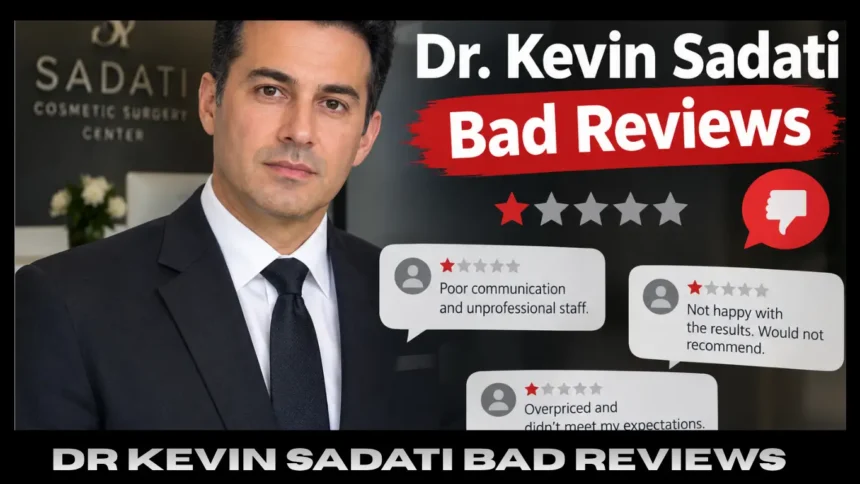
Dr Kevin Sadati bad reviews is a search term used by people researching the Newport Beach facial plastic surgeon before considering cosmetic surgery. When someone is thinking about an elective procedure involving their face, reading both positive and negative patient experiences can be an important part of their research.
Dr. Kevin Sadati is a facial plastic surgeon in Newport Beach, California, known for procedures including facelifts, neck lifts, rhinoplasty, brow lifts, eyelid surgery, and facial rejuvenation. Public review platforms contain a large number of positive ratings, but there are also individual patients who have described dissatisfaction with particular procedures and postoperative experiences.
Those negative accounts should be understood as individual patient allegations and experiences, not as independent findings that establish malpractice or professional misconduct. At the same time, dismissing detailed complaints simply because many other patients are satisfied would also provide an incomplete picture.
Who Is Dr. Kevin Sadati?
Dr. Kevin Sadati is a facial plastic surgeon based in Newport Beach, California. His professional focus is primarily on facial aesthetic and reconstructive procedures.
His areas of practice include facelift and neck-lift procedures, rhinoplasty, brow surgery, eyelid surgery, and other facial rejuvenation treatments. He is also associated with techniques focused on achieving natural-looking facial results.
Because facial plastic surgery can significantly affect a person’s appearance, patients often spend considerable time researching surgeons before scheduling a procedure. Reviews, qualifications, before-and-after photographs, consultation experiences, and postoperative care can all influence that research.
Why Are People Searching for Dr Kevin Sadati Bad Reviews?
The search for negative reviews does not necessarily mean that someone has already decided against a particular surgeon.
In many cases, prospective cosmetic-surgery patients deliberately search for complaints because they want to understand what could potentially go wrong.
This is especially relevant for procedures such as rhinoplasty and facelifts because outcomes can depend on individual anatomy, healing, expectations, surgical technique, and postoperative recovery.
Negative reviews can therefore help patients identify questions they may want to raise during a consultation.
What Do Negative Reviews Say?
Some patients have published detailed complaints about their experiences with Dr. Sadati.
The concerns described in those accounts include dissatisfaction with cosmetic results, breathing difficulties after rhinoplasty, concerns about facial changes following facelift procedures, communication problems, and dissatisfaction with follow-up or revision options.
These accounts vary considerably. Some describe specific physical concerns, while others focus more heavily on communication and expectations.
Because they are personal accounts, they should be presented as the experiences of those reviewers rather than as universal conclusions about Dr. Sadati’s practice.
Complaints About Surgical Results
One of the most serious themes found in some negative patient accounts is dissatisfaction with the final surgical result.
Cosmetic surgery is particularly sensitive in this respect because patients generally undergo the procedure voluntarily with a specific appearance in mind.
A patient may believe that a nose is too large, too narrow, asymmetrical, or different from what was discussed before surgery. Similarly, facelift patients may become concerned about scarring, facial contours, skin irregularities, or changes around the eyes and jawline.
Some patients reviewing Dr. Sadati have described concerns of this kind.
However, dissatisfaction with a cosmetic result does not automatically establish that a surgeon performed incorrectly. Medical outcomes can be influenced by healing, anatomy, scar formation, swelling, previous procedures, and individual expectations.
Rhinoplasty Concerns
Rhinoplasty appears in some of the more critical accounts associated with Dr. Sadati.
One patient described undergoing rhinoplasty after traveling from the United Kingdom to the United States. The reviewer alleged that the postoperative appearance did not match expectations and reported ongoing concerns involving breathing and scar tissue. The reviewer also described difficulties communicating with the practice afterward.
Another negative account described dissatisfaction with a rhinoplasty and chin implant and claimed that the patient later pursued revision treatment.
These are serious claims, but they remain individual patient reports. They should not be interpreted as independently verified findings about the surgeon’s overall results.
Breathing Problems After Rhinoplasty
Functional breathing is an important consideration in rhinoplasty because the operation can involve both cosmetic and structural aspects of the nose.
One critical patient account described breathing becoming worse after surgery and alleged that the patient’s concerns were not resolved to their satisfaction.
This type of complaint is particularly important for prospective rhinoplasty patients because the goal of surgery may involve more than appearance.
Anyone considering rhinoplasty should discuss both cosmetic expectations and functional concerns during the consultation and ask how potential breathing complications are handled.
Concerns About Facelift Results
Some negative accounts have also involved facelift procedures.
One reviewer described dissatisfaction following a facelift and alleged changes around the jawline and eye area. The reviewer also claimed that these concerns continued beyond the expected recovery period.
Again, these statements represent the reviewer’s account.
Facelift recovery can involve swelling, bruising, tightness, numbness, asymmetry, and other temporary changes. Some concerns can improve significantly during the healing process, while others may require further assessment.
For that reason, the timing of a negative review matters when evaluating claims about a surgical result.
Communication and Follow-Up Concerns
Another issue that appears in some critical accounts is communication after surgery.
Patients may expect quick access to their surgeon when they experience an unexpected symptom or become concerned about their appearance.
One negative rhinoplasty reviewer described difficulty arranging follow-up communication and expressed dissatisfaction with how their concerns were handled.
Postoperative communication is an important part of cosmetic surgery because recovery can continue for months.
A prospective patient may therefore want to ask specifically about follow-up appointments, emergency contact procedures, revision consultations, and what happens if an issue develops after returning home.
The Importance of Revision Surgery
Revision surgery is another recurring theme in some negative patient experiences.
A revision procedure involves correcting or modifying the result of an earlier operation. In cosmetic surgery, revisions can happen for several reasons, including healing issues, complications, asymmetry, changing expectations, or an outcome that the patient considers unsatisfactory.
The fact that a patient requires revision surgery does not automatically prove that the original surgeon made an error.
However, if someone is considering a procedure, understanding the surgeon’s approach to revisions can be useful.
Patients can ask what happens if the desired result is not achieved, whether additional surgery is possible, and what costs may be involved.
Not Every Negative Review Means the Same Thing
A major mistake when researching Dr Kevin Sadati bad reviews would be treating every negative review as identical.
A one-star review might involve dissatisfaction with the final result.
Another might concern office communication.
Another could relate to price or scheduling.
A fourth could involve an outcome that was medically acceptable but did not meet the patient’s personal expectations.
These differences matter.
The most useful approach is to read detailed reviews and identify the specific issue rather than simply counting the number of negative ratings.
Positive Patient Experiences Also Exist
A balanced article also needs to acknowledge that Dr. Sadati has received substantial positive patient feedback.
His public profiles contain many patients describing satisfaction with facelift, neck-lift, rhinoplasty, brow-lift, and other facial procedures.
Some recent patients have praised his staff, consultation process, communication, surgical results, and postoperative care.
This creates a more complicated picture than the phrase Dr Kevin Sadati bad reviews might suggest.
There are both positive and negative individual experiences, and the experiences can differ substantially depending on the procedure and patient.
Why Reviews Can Be Conflicting
It is normal for cosmetic surgeons to receive reviews that vary dramatically.
Two patients can undergo similar procedures and experience different outcomes.
One patient may heal quickly and be delighted with the result. Another may develop prolonged swelling, asymmetry, scarring, or another concern.
Expectations also differ.
A patient expecting a dramatic transformation may consider a subtle result disappointing, while another patient may specifically want a very conservative change.
This is why online reviews should be considered one part of the decision-making process rather than the sole measure of a surgeon’s abilities.
The Role of Expectations in Cosmetic Surgery
Expectations are especially important in facial plastic surgery.
Before undergoing a procedure, patients should understand what a surgeon can realistically change and what cannot be changed.
For example, rhinoplasty can alter certain aspects of the nose, but it cannot guarantee that a patient’s face will look exactly like a photograph of another person.
Similarly, a facelift can address certain signs of aging but cannot stop the natural aging process.
Clear communication before surgery can help reduce misunderstandings about the expected result.
A Case Study: A Critical Rhinoplasty Experience
A detailed negative account involved a patient who traveled internationally for rhinoplasty.
The patient reported paying a significant amount for surgery and later described dissatisfaction with both the appearance and function of the nose. The reviewer alleged persistent breathing difficulties and expressed frustration with subsequent communication.
This example highlights an important consideration for international patients: postoperative care can become more complicated when the patient lives far away from the surgeon.
Travel costs, follow-up appointments, recovery arrangements, and access to another specialist can all become more difficult.
The account is one patient’s experience and should not be treated as representative of every rhinoplasty patient.
A Case Study: The Difference Between Individual Experiences
A contrasting pattern can be seen in positive patient accounts.
Some patients have described being satisfied with their facelift or facial rejuvenation results and have praised the consultation and staff experience.
This contrast demonstrates why researching a surgeon requires more than finding one extremely positive or extremely negative review.
Instead, patients can look for recurring themes across multiple detailed experiences.
If the same concern repeatedly appears in independent accounts, it may be worth discussing directly with the surgeon.
What Patients Should Ask Before Surgery
Someone researching Dr. Sadati or another facial plastic surgeon can prepare questions before a consultation.
Important questions may include:
- What results are realistic for my facial structure?
- What are the most common complications?
- How long should recovery take?
- What happens if I am unhappy with the result?
- How are revision procedures handled?
- How frequently do you perform the procedure I am considering?
- What type of postoperative follow-up is provided?
- Who should I contact if I develop a concern after surgery?
- What additional costs could arise if revision surgery becomes necessary?
- How should I prepare for recovery?
Asking these questions can make online research more useful because the patient can then compare the answers with their expectations.
Why Before-and-After Photos Matter
Before-and-after photographs can provide another useful research tool.
However, patients should remember that photographs can vary based on lighting, camera angle, facial expression, swelling, and the amount of time between surgery and the final photograph.
A prospective patient may therefore want to see examples involving people with similar concerns and facial characteristics.
Looking at multiple examples rather than one dramatic transformation can provide a more realistic understanding of possible results.
What Online Reviews Cannot Prove
Online reviews can describe experiences, but they cannot independently establish medical malpractice.
A patient’s statement that a surgeon “ruined” a result is an expression of that person’s experience and opinion.
Determining whether a medical professional actually violated the accepted standard of care requires professional and, where relevant, legal evaluation of the medical evidence.
This distinction is important when discussing any doctor online.
It allows patient concerns to be acknowledged without presenting allegations as established facts.
Dr Kevin Sadati Bad Reviews and Due Diligence
The search for negative reviews can actually be part of responsible research.
Rather than looking only for praise, prospective patients may want to understand complaints as well.
For example, if several reviews mention concerns about postoperative communication, a patient could ask how follow-up works before booking surgery.
If reviews mention dissatisfaction with certain procedures, the patient could ask about that procedure specifically during the consultation.
The purpose of reading negative reviews should therefore be to identify questions and potential risks, not to automatically reach a conclusion based on one person’s experience.
What the Overall Picture Looks Like
The publicly available review picture for Dr. Sadati includes a substantial amount of positive feedback alongside individual negative experiences.
Some patients describe excellent results and positive interactions with the practice, while others have reported dissatisfaction with specific surgical outcomes or follow-up experiences.
That variation is important.
A search specifically focused on Dr Kevin Sadati bad reviews naturally emphasizes the negative side, but a complete understanding requires recognizing that online feedback is mixed rather than uniformly negative.
Freqently Asked Questions (FAQs)
Are there negative reviews about Dr. Kevin Sadati?
Yes. Some patients have published negative accounts describing dissatisfaction with surgical results, breathing concerns after rhinoplasty, communication issues, and other postoperative concerns.
What are the most common complaints?
The detailed complaints include dissatisfaction with cosmetic results, concerns about rhinoplasty outcomes, breathing problems, postoperative communication, and revision treatment.
Does a negative review prove malpractice?
No. A review represents an individual patient’s experience or opinion. It does not independently establish medical malpractice or professional negligence.
Does Dr. Kevin Sadati also have positive reviews?
Yes. There are many positive patient accounts describing satisfaction with different facial procedures, staff interactions, consultations, and postoperative care.
Should I rely on reviews when choosing a plastic surgeon?
Reviews can be useful, but they should be only one part of the research process. Qualifications, procedure-specific experience, consultation quality, risks, before-and-after results, and postoperative care are also important.
Why can patients have completely different experiences with the same surgeon?
Surgical outcomes can vary because of anatomy, healing, expectations, procedure complexity, previous surgery, and individual recovery.
What should I ask about revision surgery?
Ask whether revisions are offered, under what circumstances they may be considered, how long you must wait before assessing the final result, and what additional costs could apply.
Final Thoughts
Researching Dr Kevin Sadati bad reviews reveals a mixture of patient experiences rather than one simple story.
Some individuals have reported serious dissatisfaction involving surgical results, breathing concerns, communication, or revision procedures. These accounts deserve to be understood as the experiences and allegations of the patients who published them.
At the same time, many other patients have described positive experiences and satisfaction with their procedures.
For anyone researching cosmetic surgery, the most useful approach is to look beyond star ratings. Read detailed experiences, consider the timing of each review, understand the difference between temporary recovery issues and long-term concerns, and discuss specific questions directly with a qualified medical professional.
Ultimately, online reviews can help someone prepare for a consultation, but they cannot predict exactly how an individual patient will respond to surgery.
For More Visits: PopularMagazine